I'm 64 years old how do I get the financing to get the roof materials I can do the work ???
The Numbers
Your Roof Is Already Costing You Money. The Only Question Is Who Pays.
A roof is never just a maintenance item, it's a liability with a timer on it. It fails on its own schedule, not yours, and usually somewhere inconvenient — mid-storm, mid-move, or the same month you already sunk cash into something else.
So, this is a money article. We're going to walk through what replacement actually costs and which programs and claims can cover part of that bill. A lot of owners leave thousands on the table simply because nobody told them the paperwork existed.
Most owners pay full price for a roof because they never checked what they didn't have to pay for.
Roof Replacement Cost
A full replacement runs $8,000–$14,000 for a standard shingle roof — and a real share of that is often recoverable no matter what kind of property you own. Insurance RCV payouts, PACE financing, and state weatherization rebates can cover most of it, sometimes for the cost of just your deductible. Check what applies to your ZIP.
Timing matters more than most owners think. A leaking roof means a bucket in the hallway either way — the only real difference if you rent the place out is a tenant with a legal right to withhold rent or, in some states, break the lease. Insurers watch roof age and open claims closely regardless of occupancy, and visible wear can trigger a non-renewal or rate hike either way. The full cost and program breakdown is right below — it applies whether you own one roof or a portfolio of them.
The Ledger: What This Actually Costs
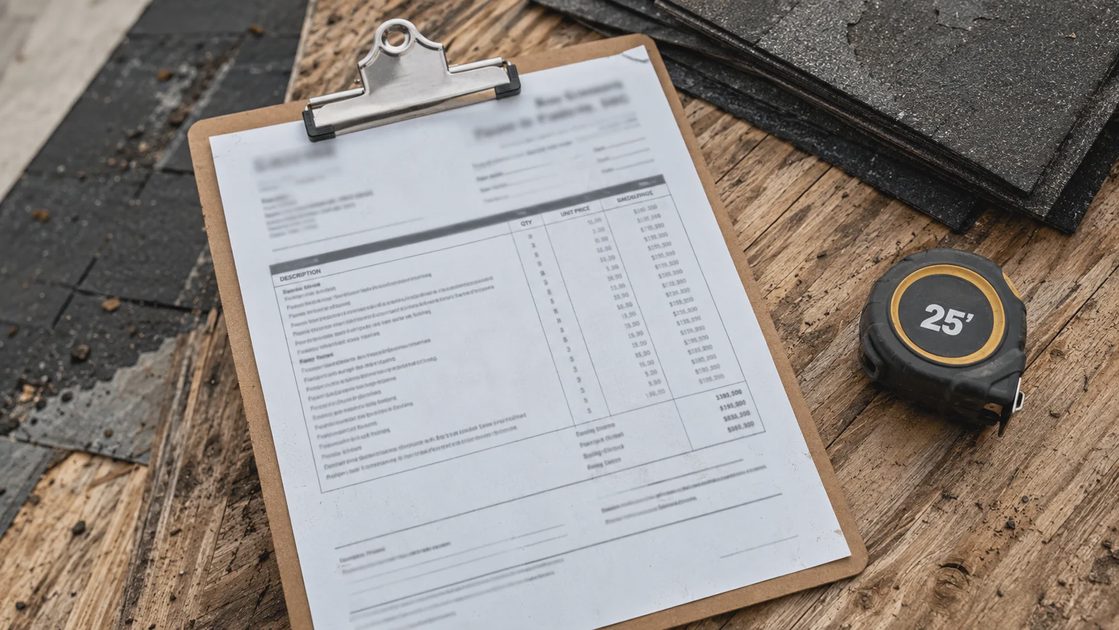
Numbers vary by region, roof pitch, and material, but here's a working range pulled from typical U.S. residential and small multi-family jobs in 2026. Treat this as a starting ledger, not a quote — your actual number depends on square footage, decking condition, and local labor rates.
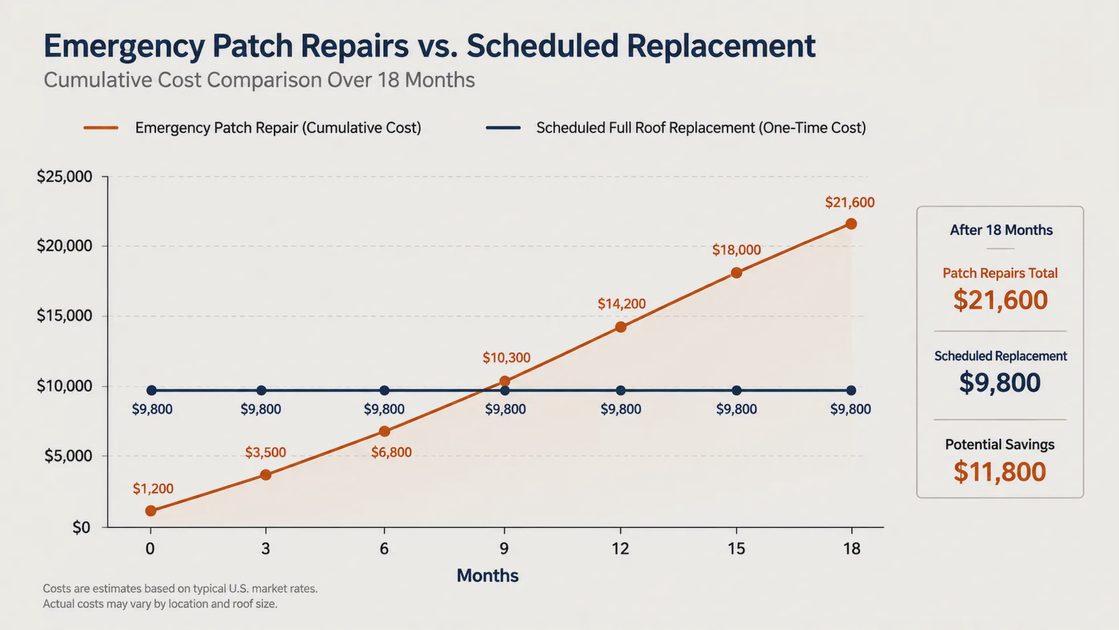
Now compare that to the cost of not replacing it on schedule. This is the number most owners never actually total up, because it doesn't arrive as one invoice — it arrives as five smaller ones spread across a year.
Stack those together and "I'll deal with it next year" quietly becomes the most expensive option on the table — often more expensive than the replacement itself, just paid in smaller, more painful installments.
Where the Money Actually Comes From
Most roofing articles cover one path: pay out of pocket. In reality, every owner has more doors to knock on than that — some tied to the property, some tied to the claim history, some tied to the tax code. Own a rental? You typically have a couple of extra doors on top of these, which we'll flag as we go. None of the following is guaranteed, and every program has eligibility rules that shift by state, insurer, and funding cycle — but if you've never checked which of these apply to your address, you're very likely leaving money unclaimed.
Insurance Claim — Storm or Wind Damage
Often 50–100% of job
If your roof damage traces to a covered event — hail, wind, a fallen limb — your policy may cover full Replacement Cost Value (RCV) rather than Actual Cash Value (ACV), meaning depreciation gets paid back to you once the work is completed and documented. This is the single largest source of "free" roof money owners miss, usually because they never filed, assumed normal wear wouldn't qualify, or didn't realize a neighborhood-wide storm event had already triggered claims for other owners on their block.
PACE Financing (Property-Assessed)
0% down, repaid via tax bill
Available in a growing number of states, PACE financing lets you fund energy-efficient roofing upgrades with no upfront cash, repaying the cost through your property tax bill over 10–20 years. Because the obligation attaches to the property rather than you personally, it's one of the few financing paths that survives a future sale without acceleration — useful if you rotate properties in and out of a portfolio.
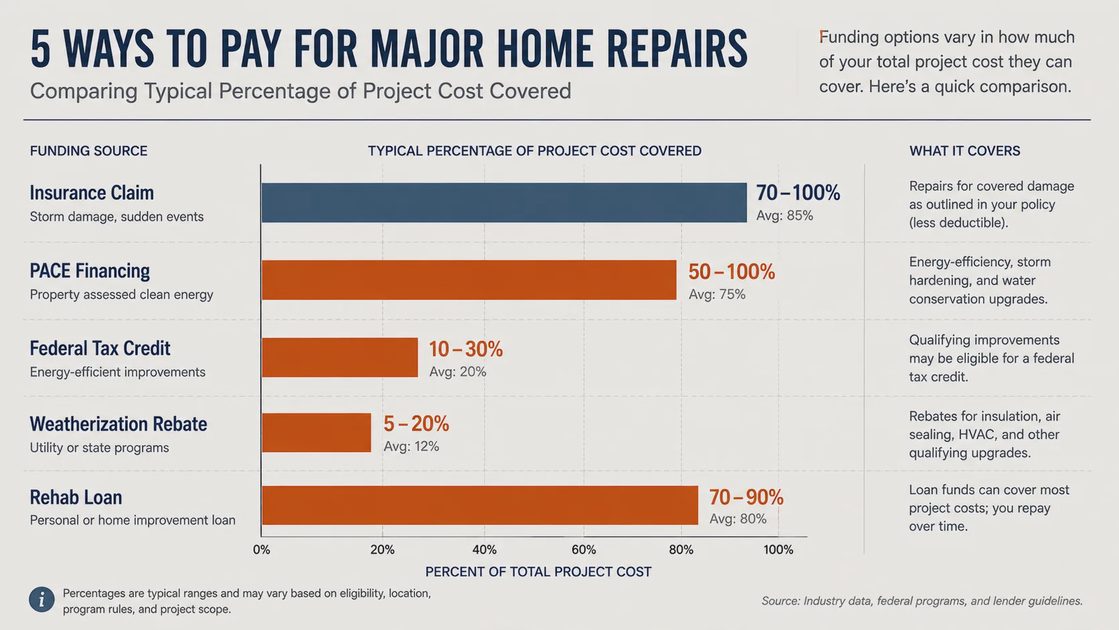
Federal Energy Efficient Home Improvement Credit
Up to 30% of qualifying cost
Certain reflective, Energy Star-rated roofing materials can qualify for a federal tax credit when installed on a property you use for part of the year or that meets program criteria — worth confirming with a tax professional against your specific property classification before you pick a material, since the credit can influence which shingle or coating makes financial sense.
State & Utility Weatherization Programs
Varies by state
Many states and local utilities run rebate or low-interest loan programs for roofing tied to insulation and energy performance, open to primary residences and often extended to multi-unit or income-qualifying rental properties too. These programs are usually funded in cycles and can close waitlists without much notice, which is the main reason owners miss them — not eligibility, timing.
203(k) / Rehab Loan Rollover
Rolled into financing
If you're financing or refinancing a property purchase — whether you plan to live in it or rent it out — roof replacement can sometimes be rolled directly into a rehab-style loan rather than paid separately in cash, which is worth checking before you close.

None of these stack automatically, and not every property or state qualifies for every line above — this is a map of where to look, not a guarantee of what you'll get. The fastest way to find out which of these actually apply to your address is to get a local assessment that checks damage, material, and current coverage together, rather than guessing from a national average.
Filing the Claim Without Losing the Roof — or the Policy
Storm damage claims are won or lost on documentation and timing, not luck. A few things that consistently separate owners who get paid from owners who get a denial letter:
Document before you touch anything
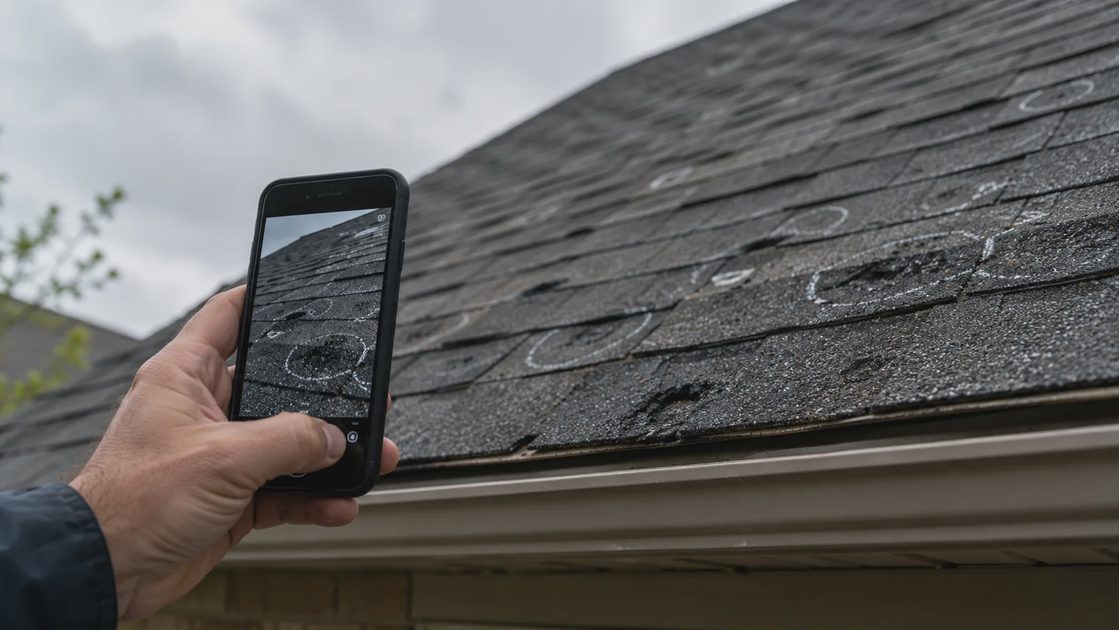
Photograph damage from the ground and, if safely possible, close up — before any tarping or temporary repair. Adjusters weigh dated, storm-consistent damage far more heavily than a description written after the fact.
Match the damage to a dated event
Insurers keep catastrophe logs by ZIP code and date. If your damage lines up with a recorded hail or wind event in your area, your claim moves faster and is harder to dispute than damage attributed to vague "wear."
Get an inspection before you assume it's something else
Interior stains get misdiagnosed as plumbing issues constantly, which sends owners to the wrong contractor first and burns the claim window. A roofing-specific inspection first is almost always the cheaper mistake to avoid.
Know your deductible before you file
Some policies carry a separate, higher wind/hail deductible than your standard deductible. Filing without checking this can mean a claim that technically pays out — but pays out less than you expected after your share is subtracted.
If You Rent It Out: Tenant-Proof the Roof, Too
The material choices below apply to any roof, but they pay off fastest on a rental. Most "tenant-proofing" advice covers the inside of the unit — flooring that survives dogs, paint that survives movers. The roof deserves the same thinking, because it's the one system a tenant can't damage but will absolutely report the moment it fails, usually at the worst possible time for your schedule.
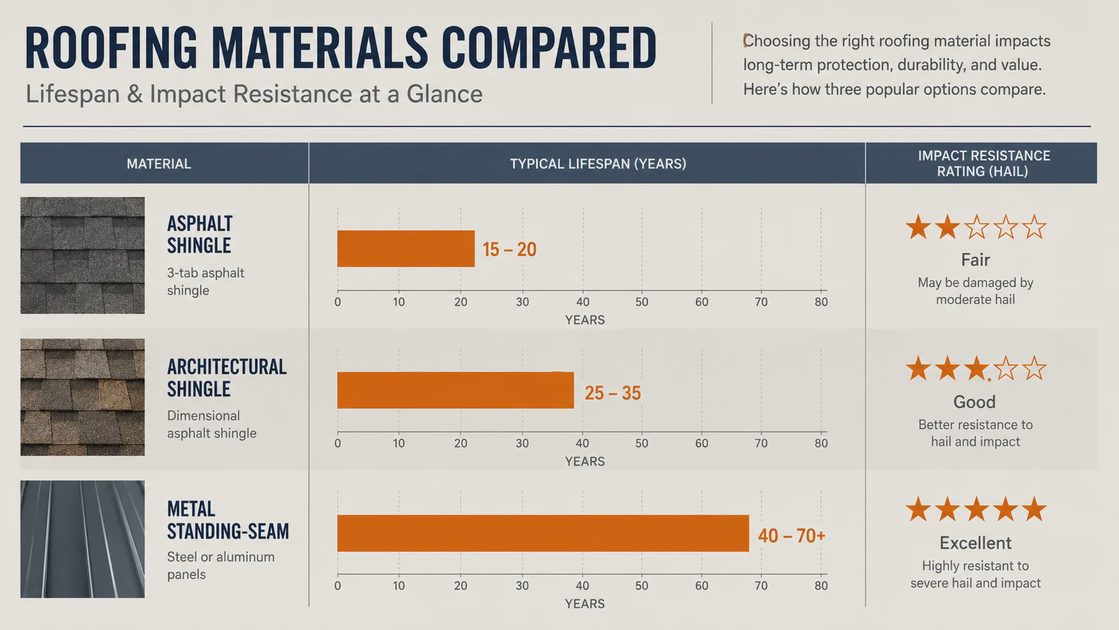
When you do replace, a few choices pay for themselves in fewer future calls, on a rental or not: impact-rated shingles in hail-prone regions (often a separate insurance discount line item), extended manufacturer warranties transferable to a new owner if you sell, and proper attic ventilation, which is the single most common reason a "new" roof still shows interior moisture within two years. A cheap install on a good material still fails early — the labor and ventilation detailing matters as much as the shingle brand on the invoice.
DIY Patch vs. Full Replacement vs. Insurance-Assisted Replacement
For anyone who reads DIY or Die Trying before anything else — here's where doing it yourself genuinely makes sense, and where it quietly costs you more than it saves.
Path | Upfront Cost | Time to Fixed | Risk |
|---|---|---|---|
DIY Patch | $50–$300 in materials | A weekend, if weather cooperates | Voids most warranties; often masks the real problem underneath |
Full Cash Replacement | $8,000–$14,000+ | 2–5 days once scheduled | Predictable, but 100% self-funded |
Insurance-Assisted Replacement | Deductible only, often $500–$2,000 | 2–6 weeks incl. claim process | Lowest out-of-pocket if damage qualifies |
The pattern that shows up again and again across owner forums and claim data alike: people who patch repeatedly end up paying more in cumulative repair and water-damage costs than owners who moved to a full assessment early — and they usually do it without ever finding out whether a claim or program would have covered most of the bill.
Quick Answers
Will filing a claim raise my premium even if it's approved?
It can, depending on your insurer and claim history — but a properly documented, storm-linked claim typically affects renewal less than an unaddressed roof that leads to a larger interior damage claim later.
Do these programs work whether I live in the property or rent it out?
Most of them, yes — insurance claims, PACE, and 203(k) rollovers apply either way. A few, like certain weatherization rebates, are also open to multi-family rentals specifically, so it's worth checking both angles for your address.
How do I know if I even qualify before calling anyone?
The fastest path is a local inspection tied to your ZIP and roof age — that's exactly what the form above routes you to, at no cost to check.
DISCLOSURE: Cost ranges are national averages for 2026 and will vary by region, roof size, and contractor. Insurance, tax credit, and financing program availability and terms vary by state, insurer, and program funding cycle and are subject to change without notice — confirm current eligibility with your insurer, a licensed contractor, or a tax professional before making a purchasing decision.
Keep Reading

The Numbers
How to Calculate Rehab Costs for a Rental Property Without Guessing
Learn how to calculate rehab costs for a rental with labor, materials, permits, ...

The Numbers
How to Value a Property Management Company Without Guessing
How to value a property management company using income, market, and asset metho...

The Numbers
Cost to Subdivide Land: A Small Landlord's Real-World Budget
Cost to subdivide land can range from a few thousand dollars to much more. Learn...
Owner Letters
6 lettersI'm 64 years old how do I get the financing to get the roof materials I can do the work ???
Contact Me 2198012269
My roof is falling in,I don't it will last to much linger
My roof is falling in,I don't it will last to much linger
My house was bought brand new back in 2006 my wife and I have been living in it for over 20 years the house is 21 years old and it needs to be repaired replaced I just lost my wife back in March of this year we would have been married 45 years September if she lived since you passed my income cut in half so I can't afford to have it done so if I can get some assistance with paying to have it repaired it would be appreciated