
How to Actually Calculate Rental Property ROI (Without the Spreadsheet Headache)
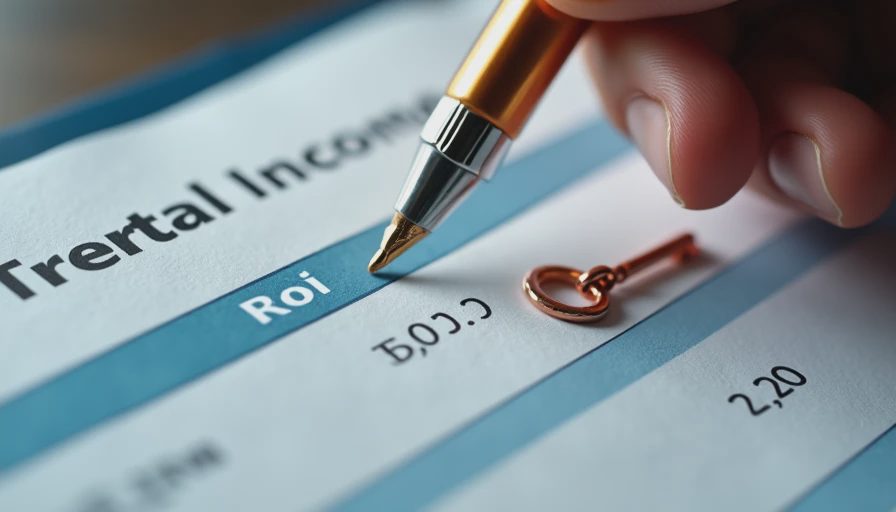
Let's talk about rental property ROI. Because I see landlords — mostly new ones — bragging about their cash flow without ever running the real numbers. Then the water heater explodes in March and that "profit" disappears. I'm not here to flex. I own four single-family rentals in the Charlotte metro area, and I run the numbers on every single door before I buy, before I renovate, and every time a tenant moves out. Here's how you do it without burning your weekends.
What the Number Actually Tells You
Rental property ROI is the return on the cash you actually put in. Not the property value. Not the gross rent. The profit you pocket after all expenses, divided by the money you had to pull out of your bank account to make it happen.
Say you put $40,000 down on a house that rents for $1,500 a month. After the mortgage, property tax, insurance, and a vacancy allowance, you clear $300 a month. That's $3,600 a year. Divide that by your $40,000 invested and you get 9% — before you account for your own labor. That's your cash-on-cash return, and it's the number I compare against every other investment I could make with that $40,000.
But here's the thing: a single house isn't a business plan. You need a rental property ROI for each property, and you need to compare them like you would compare two stocks. If one door returns 7% and another returns 4%, the second one is costing you the difference. That opportunity cost never shows up on a closing statement.
Let's Run the Numbers: The One Calculation You Need
The formula is simple. Annual net income divided by total cash invested, times one hundred. But the hard part is getting honest numbers.
Your cash invested isn't just the down payment. It's closing costs. It's the repairs you did before the first tenant moved in. It's the new fridge, the paint, the locks, the five trips to Home Depot that you never added up. I keep a spreadsheet for every property that updates as I spend. That $4.89 per square foot LVP I put in the living room? The tenant didn't pay more rent because of it. The rental property ROI calculation does not care that it looks nice.
When I run a deal, I use what I call the ugly number. That is the profit after I subtract vacancy, maintenance, and a management fee — even though I self-manage. If the property can't clear that bar, it's not worth my Saturdays.
The Costs That Eat Your Return
Here's where most landlords screw up. They calculate ROI with just the mortgage and taxes and forget everything else.
Vacancy. Plan for at least one month empty a year. Charlotte rents move fast, but you still have turnover. Between tenants, you're paying the mortgage out of your own mouth.
Maintenance. Set aside 1% of the property value per year. On a $250,000 house, that's $2,500. Some years you get away with $800. Other years a tenant calls about a sewer line and you'd happily trade your left arm for a time machine.
Property management. Even if you self-manage, price it. If you hand it to a pro, it's usually 8% to 12% of monthly rent. Put that number in your ROI, because at some point you might not want to be the one answering the 2 a.m. plumbing call.
Capital improvements. That's money you put in that you don't expect back until you sell. A roof lasts 20 years. If it costs $10,000, that's $500 a year against your return. If you skip this, your rental property ROI is fiction.

A Real Example From Charlotte
Let's run a real number set. I'm looking at a three-bedroom ranch in a decent east Charlotte neighborhood. Purchase price: $280,000. Twenty percent down is $56,000, and closing costs run about $5,500. It needs $12,000 in basic updates — paint, floors, fixtures — before the first showing. Total cash in: $73,500.
The rent is $1,850 a month. On paper, the mortgage, tax, and insurance come to $1,410, leaving $440. But after vacancy, maintenance, and a management fee, that drops to $275 a month. That's $3,300 a year. Divide by the $73,500 you put in, and the rental property ROI is about 4.5%.
Now, that's before any appreciation. Charlotte has seen prices climb, but I don't buy on that hope. At 4.5%, I could do similar in a treasury bond these days without ever getting a call about a backed-up tub. So the seller gets a pass on this one. I'm still looking.
Three Questions to Ask Before You Buy
One: Does the rental property ROI beat a boring index fund by a meaningful margin? If it's under 5%, you're taking on tenants, toilets, and termite inspections for almost nothing.
Two: Can the rent realistically grow? If the neighborhood's rents have been flat for five years, don't convince yourself that you'll be the one to double them.
Three: Could you handle six months of vacancy without breaking a sweat? Because that moment will come. Your emergency fund is your real landlord insurance.
How to Boost Your Return Without a Big Rehab
You don't have to do a full gut to move the number. Sometimes small, targeted upgrades work better. Replace a builder-grade front door with a steel one — about $400 — and it lowers break-in odds and adds curb appeal. Install a smart thermostat. Tenants like it, and it cuts down on energy complaints.
But don't overimprove. A $12,000 kitchen remodel in a $1,500-a-month rental is a passion project, not an investment. Match the neighborhood. If the comps rent for the same with older kitchens, you're donating to your tenant's next move.
Also, screen tenants like it's your only job. A good tenant who pays on time and doesn't call about burnt-out light bulbs is worth two percentage points of ROI over a year, just in saved turnover costs.
The Bottom Line
This math is not complicated, but it does require honesty. Use conservative numbers. Include every cost. And don't let the prettiest house in the street convince you to skip the math. Run your own numbers, know your real return, and only buy the deals that make sense. You're not building an empire — you're building a retirement plan, one toilet flange at a time.
Keep Reading
How to Calculate Rehab Costs for a Rental Property Without Guessing
Learn how to calculate rehab costs for a rental with labor, materials, permits, ...

How to Value a Property Management Company Without Guessing
How to value a property management company using income, market, and asset metho...

Cost to Subdivide Land: A Small Landlord's Real-World Budget
Cost to subdivide land can range from a few thousand dollars to much more. Learn...
Owner Letters
0 lettersNo letters yet — be the first to write one.